Multilingual Websites: Architecture Choices That Help Users and Search Engines
 PlaneHost team
3 min read
For a site that serves Arabic and English readers, the first decision is not translation quality — it is URL stability. Each audience should be able to open and share an address that always shows the same language. If one URL changes language based on IP location or browser settings, people share links that look different to the next visitor, and crawlers may never see some versions at all.
Pick one structure and keep it
Common patterns are subfolders (/en/), subdomains (en.example.com) or separate domains. Subfolders are usually the simplest to run. There is no rule that English must live under /en/: if a working site already has established URLs, keep them and add the new language around them rather than migrating everything.
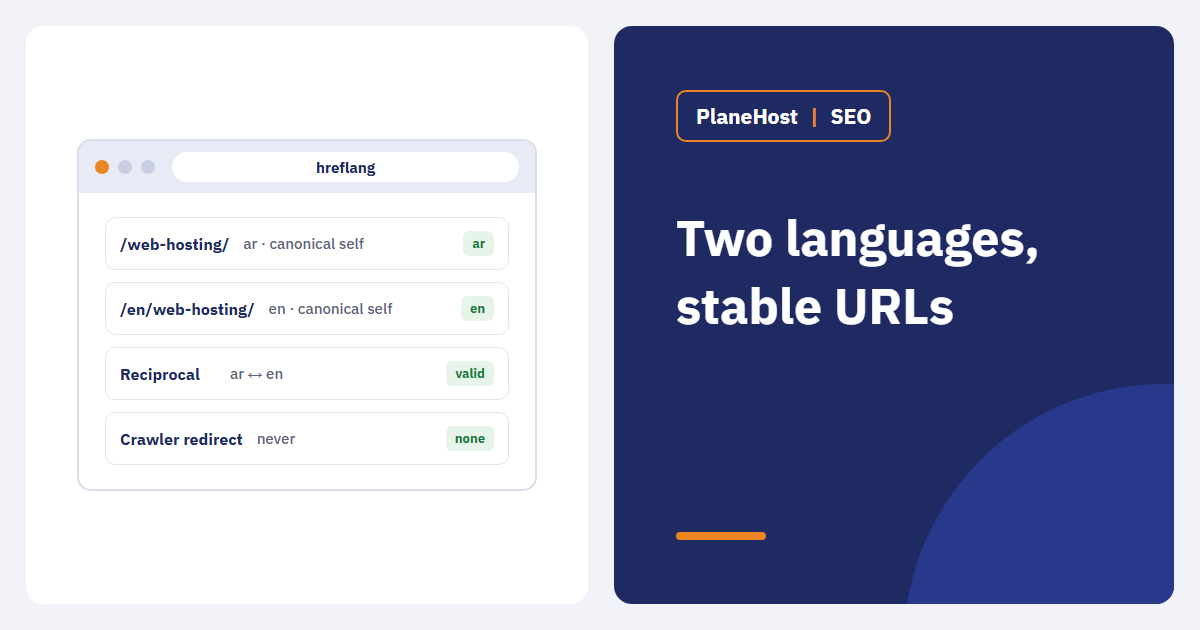
Our example: planehost.com keeps Arabic at the root (/web-hosting/) because those were the original URLs, and English lives under /en/ (/en/web-hosting/). Nothing existing had to move.
Canonical and hreflang do different jobs
- Canonical says which URL is the preferred one among duplicates. On a fully translated page, each language points its canonical at itself — never Arabic to English or the reverse.
- Hreflang says "this page also exists in these languages". The links must be reciprocal: if the Arabic page lists the English one, the English page must list the Arabic one back.
- x-default is optional and names the version for everyone else.
Never add hreflang to translations that do not exist. Our English blog posts, for example, are written separately for an international audience rather than translated from the Arabic ones, so they carry no hreflang pairs — only their own canonical.
Be careful with automatic redirects
Google recommends not forcing visitors to a language based on location. We made one deliberate compromise and it is worth showing how to do it safely: visitors from outside Arab countries who open an Arabic service page are sent to its English twin, but only when a twin exists, search-engine crawlers are never redirected, and anyone who chooses Arabic in the language switcher is remembered and never redirected again. If you cannot meet all three conditions, use a suggestion banner instead of a redirect.
Translate the whole interface
Navigation, breadcrumbs, buttons, form errors, prices, checkout steps and confirmation emails — not only headings. Make the language switcher visible, and send it to the same page in the other language, not the homepage. Keep titles, descriptions and structured data in the page's own language, and test right-to-left layout with mixed Arabic text, English product names and numbers on small screens.
A launch test that catches subtle mistakes
Pick five page types — home, a service page, pricing, a blog post, the contact form. For each language, in a private window, record: final URL, HTTP status, html lang, canonical, hreflang, internal links and form behaviour. Repeat as a visitor from another country. Then compare indexing by language in Search Console. Our free SEO checker shows the status, canonical and meta tags for any URL.
Takeaway: multilingual SEO is as much about URLs and navigation as tags. The architecture should get each reader to the right language — and keep them there.
Reference: Google Search Central — Localized versions of your pages.